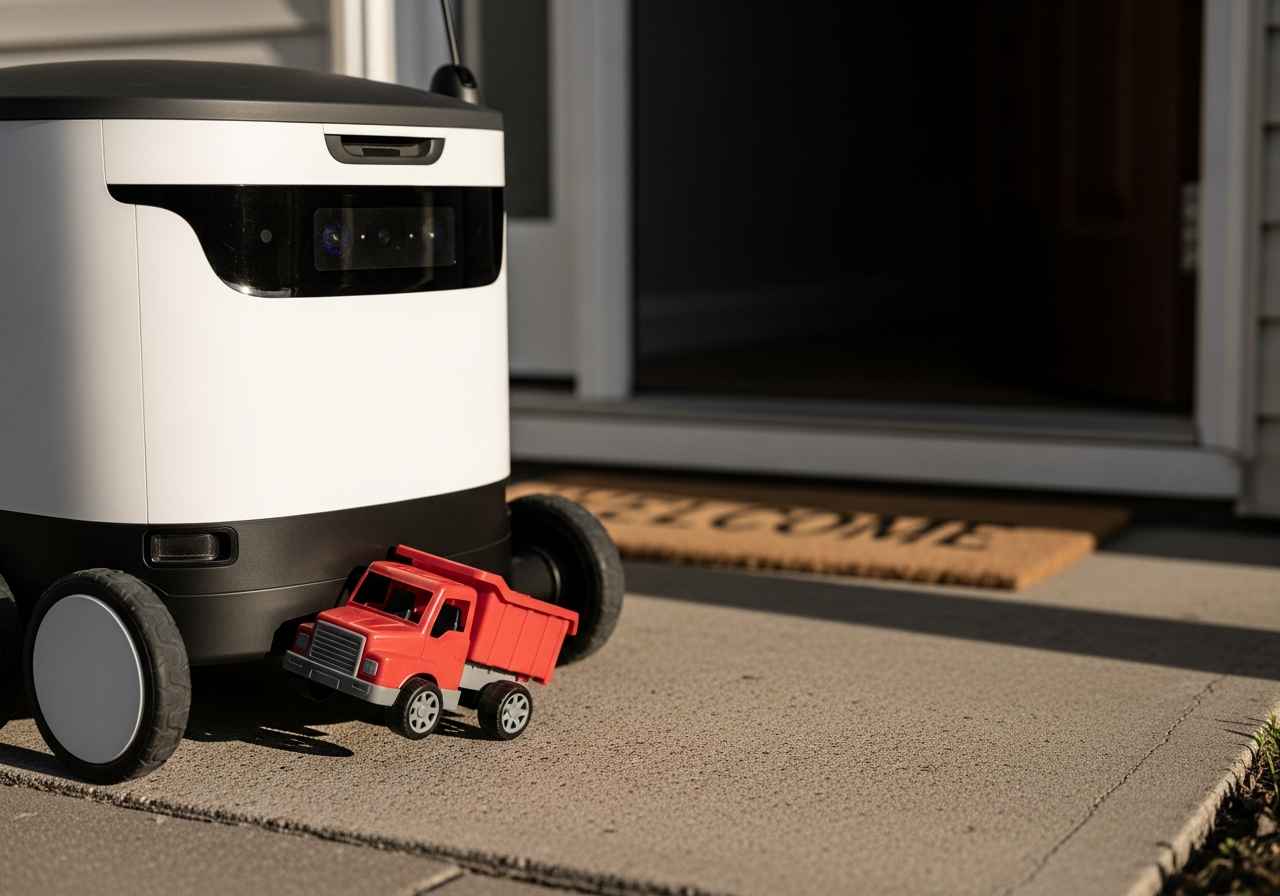
There is that smooth delivery robot rolling along your street. It is a wonder of modern AI robotics, being able to cross cracks and curbs with ease. But see what becomes of it when it comes home. This technological wonder on a whim stalls. One stride, a hose of garden loos–the shut gate–they are already walls which can be neither broken nor climbed. This is the dirty little secret of this industry the problem of the last centimeter. And it is coming much harder than anybody guessed.
The Sidewalk is a Lie: Why Maps Fail at Your Mat
We have been sold an image of smooth free will. Such companies as Starship Technologies perfected campus quads. Their six-wheeled robots have the digital maps that are spotless. But it is not a campus you are in front of. It’s an unmapped wilderness.
- Here edge cases are not edge cases they are the entire environment. One day it’s a tricycle. The second, a competitor delivery. A sensor can consider a wet doormat to be a bottomless pit. According to a quip by one of the roboticists involved in the reporting of Wired, “99 percent of the journey could be solved. The 1% of it consists of 99 percent of the headaches.”
The sidewalk was mere going through the motions. The actual challenge commences at the property line.
The Humble Doormat, Stairs, Gates, and an Impossible Trinity
We may dissect this comedy of errors. First, stairs. The majority of delivery robots are on wheels. Stairs are not geometically possible. Even a single step is a cliff.
Gates are a nightmare when it comes to manipulations. Even a basic instance of a latch would need to be a matter of dextrousness and logic which is what modern AI cannot yet perform. Should it push? Pull? Twist?
Then there’s the porch itself. Is this a welcome mat or a sinkhole? Is it that snorting bush, a cat or danger? The variations are infinite. Each house is a puzzle to itself.
Humanoid Robot Pipe Dream: Is it Over-Engineering?
Then is it the solution, humanoid robot? It’s a compelling idea. In order to survive in a human world, create a machine made in the shape of a human being. Figure AI is a startup that is betting on it. Their argument? Two legs climb stairs. Two arms open gates.
But let’s be real. It is equivalent to driving to pick your mail in a Formula 1 car. The cost is astronomical. The intricacy is head boggling. It is economic nonsense to install a million dollar machine to publish a paper-back book. It also addresses the technical problem by developing a financial concern.
Case Study: Quiet Retreat at Amazon Scout
Can you remember the cute and cooler-sized Scout of Amazon? It was put into service in 2019 with much excitement and retired in 2022. Why? Difficulties related to uneven surfaces and obstacles were mentioned. In other words, the real world.
This was not an engineering failure but environmental one. There is no way Amazon would code in every personality of a porch with its billions. They have since switched investment to drones and bigger autonomous vans. They simply chose to fly over the issue- or pull up at the kerb.
So, What’s the Real Fix? Bypass, Don’t Conquer
Perhaps we are addressing the wrong problem. The most intelligent brains in AI robotics are not only battling with the porch but they are building around it.
Between-the-world-and-me lockers. Or intelligent car whereby the bot opens your trunk. My personal favorite idea? An ugly, stupid, inexpensive home receiver dock. The fancy bot comes, takes the package and goes. The dock does the last pick on to your bench.
This isn’t a surrender. It’s a strategic pivot. Why make a square bot fit into the round and chaotic hole?
The Hurdle that is Unseen: You and Your Neighbors
The social friction seldom comes up. What is your opinion about a camera-equipped robot loitering outside your house? They were creepy or annoying to communities in the first test regions. The issue of privacy laws is a time bomb to this sector.
Aesthetics matter, too. Would we have our pavements full of humming machines? The social approval is the fragile wall that is as difficult to be punctured as a rock step.
An Establishment of Robotic Humility: The Hybrid Future
I have decided to come to a conclusion after talking to engineers and reading thousands of post-mortems. The winning model will not be complete autonomy. It will be a handoff.
A self-driving van or a huge bot reaches the neighborhood. The walk can be processed by a smaller specialized device. To this day, man may still make that final move. This isn’t a failure of AI. It is a recognition of the fact.
We created a beautiful complicated world of our own. Our stair cases, our mess, our personal gardens–they are monuments to human existence. It is mere hubris to expect a robot to learn it within a couple of years.
The final takeaway? When it comes to the last centimeter, it is not a robotics problem. It’s a mirror. It teaches us how lovely, exasperatingly disheveled human life may be. And perhaps that is landscape which we ought to preserve to ourselves a little longer.