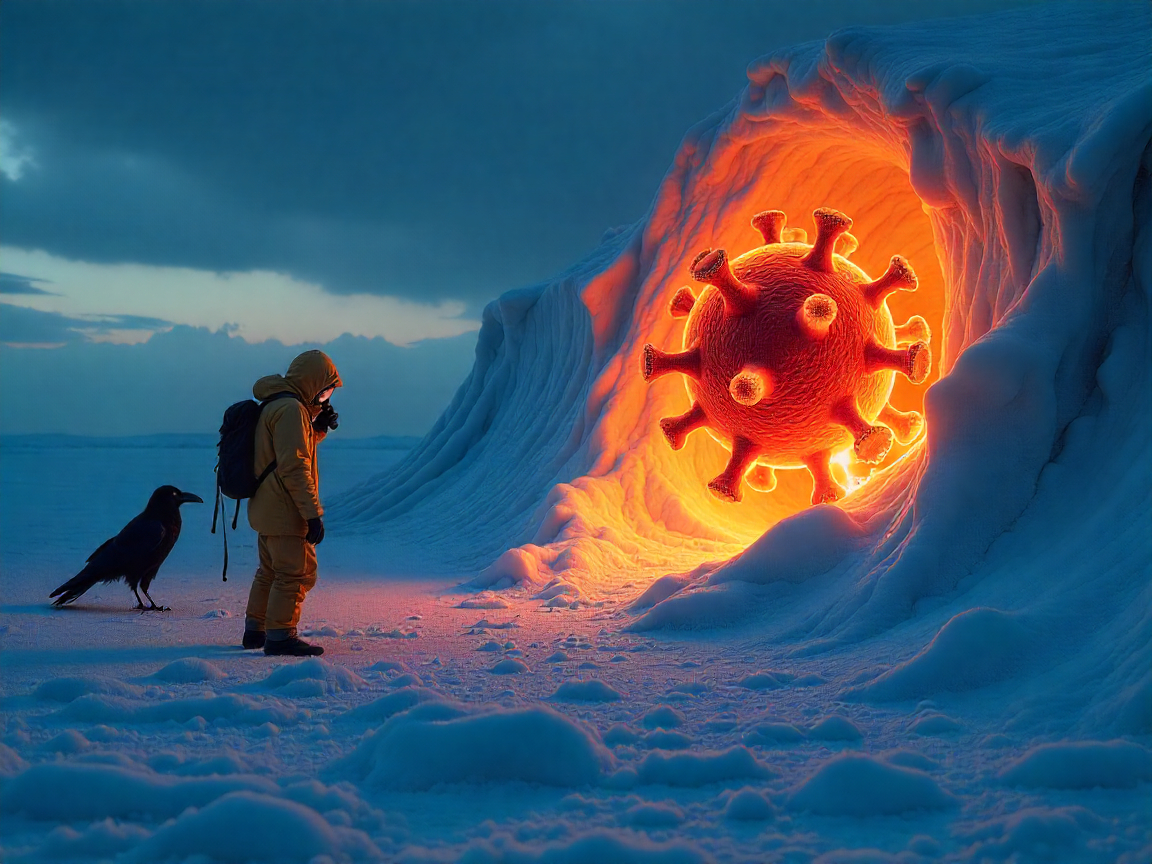
A Chilling Discovery Beneath the Ice
That is like a virus that is 48,500 years old going to sleep and still being contagious. Precisely the latter is what occurred in 2023 when French researchers brought Pandoravirus yedoma back to life in Siberian permafrost. It is not a sci-fi, it is real and it is going on right now.
Due to encroachment of climate change that is increasing the rate of thawing of the arctic, long dormant microbes are being brought to life. Many of them, such as Pandoravirus, only infect amoebae-Pandoravirus, to date. But what would be more on Diaghilev, than something more deadly behind the ice? The 2016 Siberian anthrax outbreak that was caused by a melting carcass of a reindeer shows this is not mere speculation. Is that something to be concerned about?
The Science of Zombie Viruses: How Do They Survive?
Permafrost is the freezer that preserves viruses long after they have died. The cold, oxygen-free environment is a bit like a time capsule: genetic material is preserved there in exceptionally good condition. As of 2014, a 30,000 year old giant virus known as Pithovirus sibericum had been revived and inoculated into amoebae, which became infected within hours.
Here comes the twist there are bad ones not all of them are harmless to the human beings. It is only the beginning, according to scientists, because there is still a long way to go before Pandoravirus has been thoroughly studied.
2017 A team of researchers discovered the remains of the Horsepox virus (a relative of the smallpox virus) in mummies that are 17th-century old. Could a similar virus thawed out today spread as well?
We are digging our way blindly into a biological minefield, warns Dr. Jean-Michel Claverie professor of virology at the Aix-Marseille University.
Could These Viruses Jump to Humans?
The threat is minimal-but not negligible at the moment. Most of the revived viruses do not infect mammals. Yet nature is unpredictable and there could be unknown pathogens thousands of years old.
- Professional Perspective Birgitta Evengard (Umea University) cautions that climate is changing faster than new research can be done. So, we do not even have a system of global surveillance of pathogens in permafrost.
- Real-World Data: The temperature in the arctic is increasing four times faster than the global average (NASA, 2023). By the year 2100, as much as 70 percent of the permafrost may thaw and reveal the underlying older sections.
The anthrax outbreak in the Siberian region of 2016 was quite an awakening call. Only one thawed spore infected over 100 people and killed a child. What would we do in the event that such an ancient virus turned out?
Are We Ready? The Biosecurity Leaks
The thing about this is that no one is systematically monitoring this stuff. It features no WHO task force, no emergency protocol at the UN, only research groups sprinting after melting ice.
What’s Missing?
- It plans an international permafrost pathogen database to characterize threats.
- Tighter regulations of drilling and digging in the Arctic.
- More investment in viology by the climatic science establishment (neglected at present).
The V, outcome at the Yamal Peninsula in Russia demonstrated that past surprises cannot be dealt with by the health systems at local levels. Would we know it in time, should one of the prehistoric ancestors of small pox appear?
Final Verdict: Should We Panic?
No–but we must make ready The chances of a zombie virus pandemic are low, but when it comes to climate change doors are being opened we cannot shut.
The real question: Why not preserve lots of money on asteroid defense when we can spread lots of money on the pathogens that are buried in our own backyard? Maybe the next pandemic will not be because of a wet market, but because of the Ice Age.
Do you think so? Are we discounting the oldest insect threats of nature? Talk in the comments.